


Heterogeneous collectives, Coalescence avalanches & pyDaDDy
Arshed was the very first student to join my lab way back in 2018, when I had just joined IISc as an INSPIRE faculty. He was transitioning from academia to industry and he had a few months to spare and hence he decided to join my project. We analysed the data of schooling fish (from Vishu's lab) where the fish were swimming together as one cohesive school, in a tank 2 meter wide, making spontaneous turns as they swam in the tank. We wondered if we could predict the turn the school exhibited in advance from the noisy turns the individuals were doing. But the features we extracted from data were inadequate to explain the observed spontaneous turning.
A year and a half later, he was done with industry and wanted to get back to academia and joined my lab as he was transitioning back to a PhD. At that time, I had just finished a draft of a (single-authored) manuscript about heterogeneous collectives (made up of different types of agents), inspired from my experience travelling in the infamous Mumbai local trains. I was interested in understanding how easy or difficult it would be for an 'observer' (a computer program), collecting information from say CCTV footage, to identify if someone in the dense crowd needed help at some point of time. I had concluded that it was very difficult to classify agents reliably into their types just from their movement information. While a thorough analysis was done and the paper was well-written and ready to sent for peer-review, I was not entirely satisfied with the ending. I wanted a more positive conclusion and so I decided to give the problem to Arshed who was joining our lab that time. His task was to figure out a creative ways to accurately classify agents from their movement information.
Very soon he figured out the missing link. We were using velocity information of an agent to identify an agent's intrinsic nature (its type). But the agent's velocity which the observer sees, is a result of both the agent's intrinsic nature and the interactions it has with its neighbours. After some iterations we figured out a proxy to calculate the effect of interactions on the observed velocity, which we termed as the "neighbourhood parameter", and proposed a new method to classify agents. Behold, the classifier worked! It was able to classify an agent as one with an intent to move say in positive x direction, even if it were dragged in the opposite direction by its neighbours, the entire time. Arshed wittily remarked that the classifier was "reading the mind of the agent".
We wrote the paper up. What was initially my single-authored paper was now Arshed's manuscript where he totally championed the work, writing every section from scratch making some really fantastic figures and supplementary videos. But to our dismay we had quite some trouble publishing our paper. We had a lot of rejects. People found it hard to understand and appreciate, esp. because the question we asked was new and non-obvious; not many work at the interface of 'estimation' and 'collective dynamics'. But finally we ended up publishing the work in Chaos journal where we got fantastic reviews. By fantastic I mean, the reviewers understood the work fully and asked very nuanced questions that we absolutely enjoyed answering. This is one manuscript, where every we paid so much attention to writing every single line in the paper.
This study has opened CoPhe lab in a new direction altogether. We found that the approach we developed had applications in many real world systems. For instance, in male-infertility research, sperm cells are to be classified into different classes based on their motility. The state-of-the-art methods prescribed by WHO do not consider the effect of neighbourhood on this classification process. Our method will likely improve the classification and estimation of fertility.
After this stint, Arshed took up a PhD position with my collaborator Vishwesha Guttal at CES, IISc, through the Interdisciplinary mathematics initiative (IMI). We continued to work on common projects. He worked on developing the PyDaDDy python package to extract stochastic differential equation from noisy time series data. We published this work in American Naturalist.
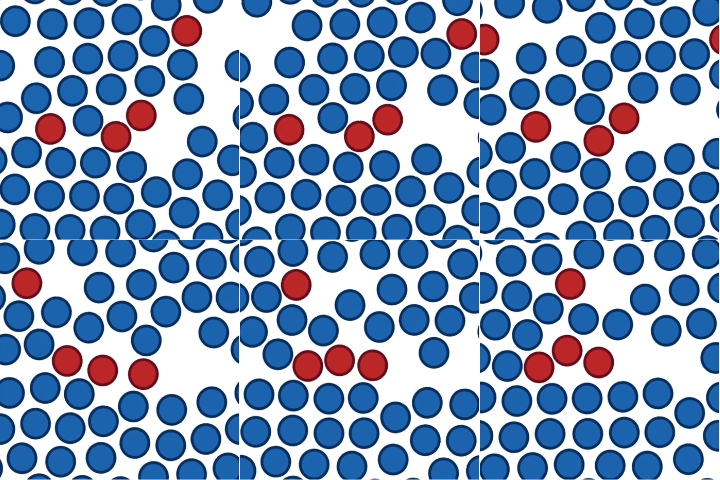
I always enjoyed chatting with Arshed over coffee where we discussed a variety of problems. In one of our conversations we realised that an old problem that I was revisiting had some interface with graph (network) theory. It was on the explosive propagation of coalescence avalanches through a 2D concentrated emulsion in a microchannel. We wanted to predict the likely propagation of the avalanche as a function of how the droplets were packed together. The features of the packed structure we were interested in were in some sense characterising the underlying network structure. So I roped Arshed to the problem and soon we had a network-based model where we used the average degree (local quantity) and conductance (global measure) to explain the dynamics as function of the packing. We published it in EPJ special topics.
We continue to work on topics of common interest to this day.